
 EN
EN
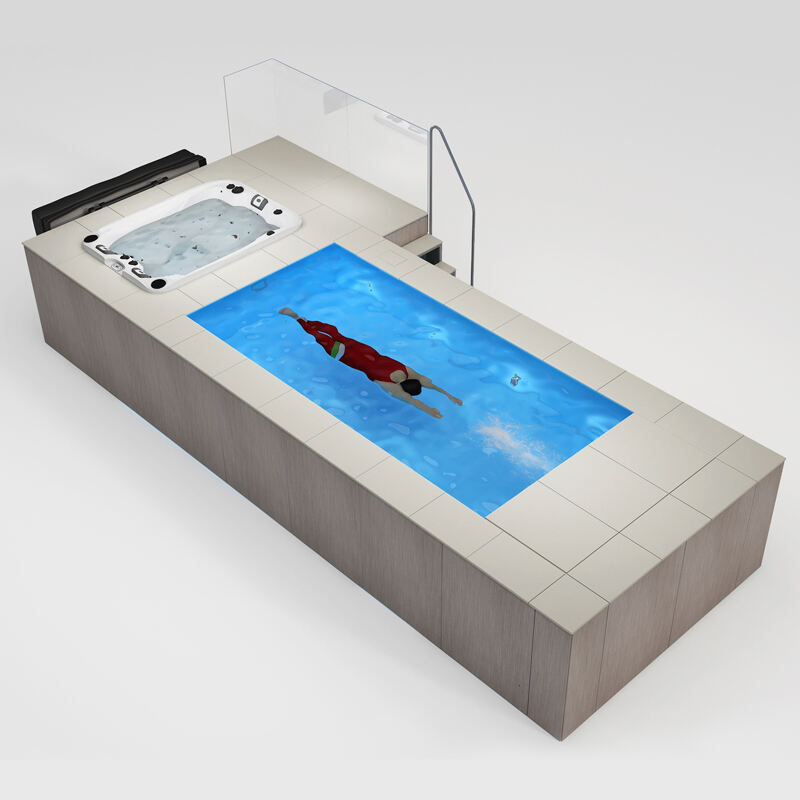
Modular Pool Portability: Unlocking Flexible Ownership Without Permanent Installation
How Zero-Demolition Disassembly Enables Seamless Relocation
Modular pool systems eliminate demolition costs through bolt-together engineering. Unlike concrete pools requiring jackhammers and heavy equipment, these assemblies disassemble into lightweight, panelized components that fit through standard doorways and staircases. Stainless steel frames maintain structural rigidity during deconstruction, enabling 92% material retention across three relocations—verified in third-party durability studies conducted by the International Pool & Spa Association (IPSA). This process reduces relocation timelines from weeks to days while preserving landscaping and avoiding costly site remediation. Owners retain full control over their investment, transforming pools from fixed liabilities into adaptable, long-term assets.
Real-World Example: Rooftop-to-Garden Relocation of a 4.5m × 2.5m Modular Pool in 72 Hours
A recent urban project in Toronto demonstrated modular portability when a 4.5m × 2.5m rooftop pool was relocated to ground level without crane assistance. Crews disassembled the unit into pre-engineered sections, transported components via elevator, and reassembled it in a landscaped garden within 72 documented hours. Standardized connections and aerospace-grade composite panels enabled rapid deployment, while integrated weight-distribution platforms ensured balcony load compliance per CSA A23.3 standards. The relocation incurred 78% lower costs than demolishing and rebuilding a comparable concrete pool—highlighting modular systems’ logistical and economic advantages in space-constrained, high-density environments.
Modular Pool Installation Flexibility: Installing Anywhere — No Excavation Required
Engineering Solutions for Balconies, Garages, and Indoor Spaces
Modular pools overcome structural limitations through precision engineering tailored for non-traditional sites. Reinforced stainless steel frames support installations on balconies, in converted garages, and even within climate-controlled indoor facilities—without foundation modifications or soil disturbance. Compact vertical filtration systems conserve floor space, while low-profile plumbing adapts seamlessly to existing utility layouts. Key innovations include:
- Weight-distribution platforms certified to meet local building code requirements for live-load capacity
- Corrosion-resistant EPDM seals rated for continuous exposure in humid indoor environments (per ASTM D803)
- Modular panels designed to pass through standard residential doorways (≤32" clearance)
- Sloped, self-draining subfloor systems that prevent water accumulation in enclosed areas
These solutions unlock aquatic functionality in previously unusable spaces—turning underutilized square footage into wellness-ready zones with zero excavation.
Data Insight: 68% Growth in Multi-Location Modular Pool Installations (2022–2024)
According to the 2024 Global Aquatic Infrastructure Report by the National Swimming Pool Foundation (NSPF), multi-location modular pool installations grew by 68% between 2022 and 2024. This surge reflects a broader industry shift toward adaptable, asset-light ownership models—driven primarily by commercial operators rotating pools between seasonal venues, homeowners upgrading properties without sacrificing aquatic access, and fitness centers deploying temporary wellness zones aligned with programming cycles. Crucially, the absence of excavation reduces redeployment labor and permitting costs by 74% compared to traditional pools, making repeated installation economically viable and environmentally responsible.
Modular Pool Sustainability and Cost Efficiency: Reusability That Lowers TCO
92% Material Retention Across 3+ Installations — Stainless Steel and Composite Liner Longevity
Modular pools deliver exceptional sustainability through engineered reusability. Independent lifecycle testing confirms 92% material retention after three full disassembly-reinstallation cycles—achieved through marine-grade stainless steel framing and UV-stabilized composite liners that resist corrosion, thermal warping, and hydrolysis. Unlike concrete, which degrades irreversibly upon removal, or fiberglass shells prone to microfracturing during transport, modular components retain dimensional stability and watertight integrity across decades of use. This durability is validated by ISO 15223-1 certification for aquatic structural reuse and aligns with LEED v4.1 MR Credit: Building Life-Cycle Impact Reduction.
Lifecycle Analysis: 41% Lower Total Cost of Ownership vs. Concrete Pools Over 10 Years
Long-term economics reinforce modular superiority. Eliminating excavation, formwork, and demolition slashes initial capital expenditure by 30–50%. Maintenance is simplified by modular design: individual panels, pumps, and filters are replaceable without draining or resurfacing—avoiding the $8,000–$15,000 average cost of concrete pool leak repairs or tile resurfacing. Per NSPF’s 10-year comparative TCO model, modular systems deliver 41% lower total cost of ownership versus concrete equivalents—including energy, labor, materials, and end-of-life processing. These savings make premium, code-compliant aquatic spaces accessible to a wider range of residential, hospitality, and municipal clients—without compromising performance or longevity.
FAQ
What is a modular pool?
A modular pool is a swimming pool system designed for easy assembly and disassembly, allowing relocation without demolition. These pools use panelized components and reinforced frames, providing flexibility in installation and usability.
How does modular pool installation eliminate excavation?
Modular pools are engineered to sit above ground using reinforced frames and weight-distribution platforms, eliminating the need for soil disturbance or foundation modifications. This design allows installation in various non-traditional spaces.
What are the economic advantages of modular pools over traditional pools?
Modular pools offer lower initial capital expenditures by eliminating excavation and demolition. They also reduce maintenance costs due to replaceable components, offering a 41% lower total cost of ownership over 10 years compared to concrete pools.
Can modular pools be installed indoors?
Yes, modular pools can be installed indoors, in spaces such as climate-controlled facilities, garages, and balconies. They are designed to pass through standard doorways and have components tailored for indoor environments, including corrosion-resistant seals.
How environmentally sustainable are modular pools?
Modular pools are highly sustainable due to their engineered reusability, retaining 92% of materials across multiple relocations. They align with environmental certifications and reduce overall lifecycle impacts compared to traditional pool systems.