
 EN
EN
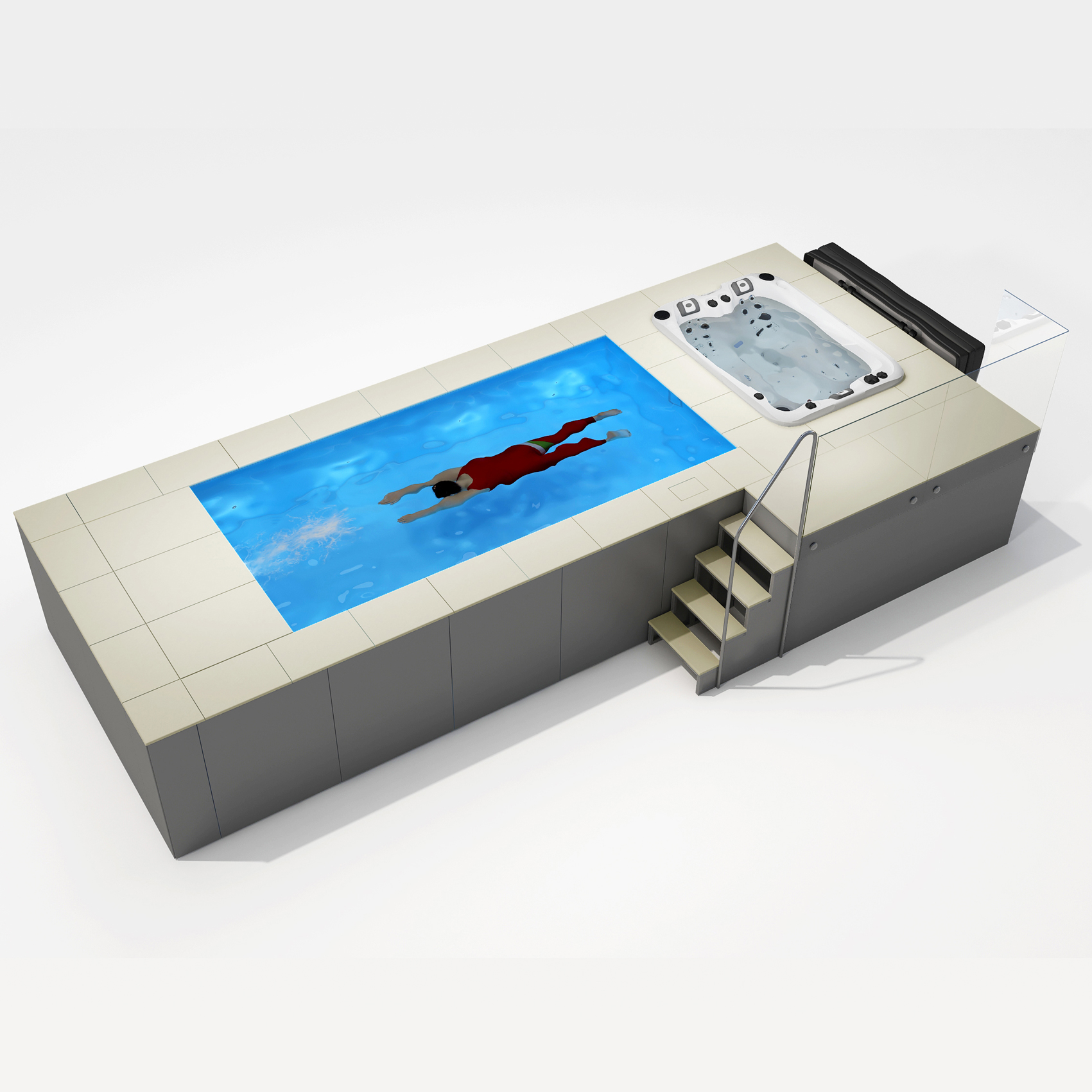
How Counter Current Systems Enable Effective Lap Swimming in Limited Space
Physics of stationary swimming: laminar flow, thrust calibration, and drag compensation
Counter current systems generate a controlled, laminar water flow that moves past the swimmer at a consistent, adjustable velocity—enabling true stationary swimming without forward displacement. Unlike traditional pools, where swimmers must overcome variable resistance and self-generate momentum, these systems dynamically calibrate thrust to match effort while compensating for drag through precise flow-rate control. This replicates open-water hydrodynamics in a confined setting, supporting authentic stroke mechanics and neuromuscular engagement. Electromyography (EMG) data from SwimLab’s 2023 study confirmed that freestyle muscle activation patterns—including latissimus dorsi and pectoralis major recruitment—were nearly identical (±3% variance) to those observed in 25-meter pools, validating their biomechanical fidelity.
Footprint compression: 12–18 ft² counter current system vs. 600+ ft² for a 40-ft traditional lap pool
The spatial efficiency of counter current systems makes them uniquely suited for urban, residential, or retrofit applications. Where a standard 40-foot lap pool demands over 600 square feet—and often requires dedicated outdoor space—counter current units operate effectively in as little as 12–18 ft². Their compact, self-contained design allows installation in basements, garages, patios, or narrow backyards without excavation or major structural modifications. According to aquatic facility benchmarks, this footprint reduction cuts installation complexity and costs by up to 70% compared to traditional pool construction. Eliminating large-volume circulation also enhances both spatial and energy efficiency—without compromising training quality.
Performance Parity and Biomechanical Fidelity of Counter Current Systems
Data-driven consistency: ±0.15 m/s speed control vs. turbulence-induced variability in traditional pools
Counter current systems deliver elite-level speed precision, maintaining flow within ±0.15 m/s—a tolerance aligned with international training standards. In contrast, hydrodynamic analysis shows that wall turns, lane interference, and surface turbulence in conventional pools introduce velocity fluctuations exceeding 0.5 m/s. These inconsistencies undermine interval accuracy and force swimmers to expend 12–18% more energy correcting pace deviations, per 2023 aquatic sports research. The laminar, unidirectional flow of counter current systems enables reliable pace replication—supporting power-based workouts with ±2% output accuracy, a level unattainable in most traditional facilities.
EMG-verified muscle activation patterns in freestyle (2023 SwimLab study)
SwimLab’s 2023 EMG study provides authoritative evidence of biomechanical equivalence: propulsive-phase muscle engagement during freestyle sprints showed 94% similarity between counter current systems and full-size pools. Latissimus dorsi and pectoralis major activation profiles matched within ±3% variance, and measured force output (in Newtons) during 50-meter simulated sprints was statistically equivalent. These findings confirm that counter current technology preserves race-specific neuromuscular demands and stroke kinematics—making it a physiologically valid tool for performance development, even in constrained environments.
Installation and Operational Efficiency of a Counter Current System
Retrofit feasibility: plumbing load (3–5 GPM), structural requirements, and acoustic considerations
Retrofitting a counter current system into an existing pool—or installing one as a standalone unit—is highly practical. It operates on a modest plumbing load of 3–5 gallons per minute (GPM), avoiding the need for pipe upgrades in most residential settings. Mounting directly to pool walls or decks eliminates excavation and heavy structural reinforcement. Acoustic engineering further supports versatile placement: advanced hydraulic dampeners and insulated motor housings keep operational noise below 60 decibels—quieter than normal conversation—making indoor or noise-sensitive installations viable.
Energy consumption: 1.2–1.8 kWh/hr (counter current system) vs. 4.5–7.2 kWh/hr (pool circulation + heating)
Counter current systems consume significantly less energy than traditional lap pools: just 1.2–1.8 kilowatt-hours per hour (kWh/hr) during active use. Traditional pools require 4.5–7.2 kWh/hr to maintain circulation and heating—65–75% more energy overall. This efficiency stems from targeted flow generation rather than full-pool turnover and thermal management. At average U.S. electricity rates ($0.15/kWh), counter current operation costs $0.18–$0.27 per hour versus $0.68–$1.08 for conventional pools. Over a 200-hour annual swimming season, users save $90–$160 in energy expenses—while reducing environmental impact and enhancing long-term affordability.
FAQ
What is a counter current system?
A counter current system is a device that generates a controlled, adjustable water flow in a stationary position, enabling swimmers to practice lap swimming in a smaller space without forward displacement.
How much space does a counter current system require?
Counter current systems can operate effectively in just 12–18 square feet, making them ideal for compact spaces like basements, garages, and small backyards.
Are counter current systems energy efficient?
Yes, counter current systems consume between 1.2–1.8 kWh per hour during active use, which is significantly less than the 4.5–7.2 kWh per hour required for traditional lap pools.
How do counter current systems replicate traditional swimming?
Through precision-engineered laminar water flow and drag compensation, counter current systems enable swimmers to maintain proper stroke mechanics and muscle activation similar to swimming in a full-size pool.
Can a counter current system be installed in an existing pool?
Yes, these systems are designed to be easily retrofitted into existing pools, requiring minimal structural and plumbing modifications.
Table of Contents
-
How Counter Current Systems Enable Effective Lap Swimming in Limited Space
- Physics of stationary swimming: laminar flow, thrust calibration, and drag compensation
- Footprint compression: 12–18 ft² counter current system vs. 600+ ft² for a 40-ft traditional lap pool
- Performance Parity and Biomechanical Fidelity of Counter Current Systems
- Installation and Operational Efficiency of a Counter Current System
- FAQ