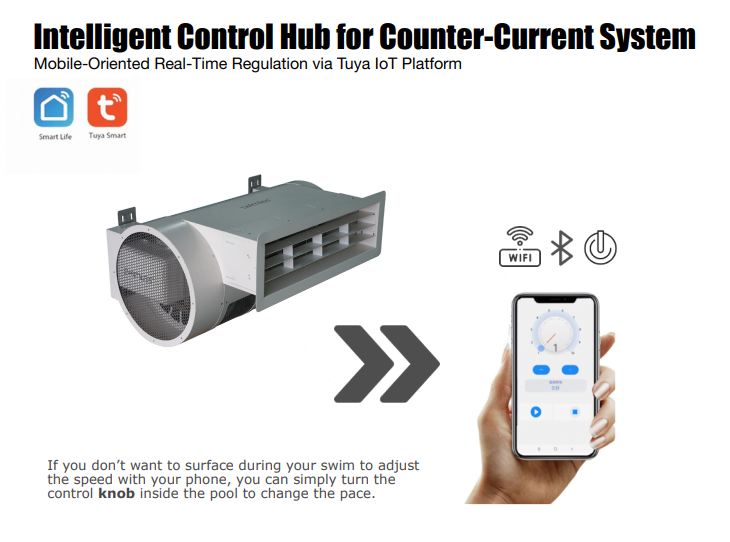
Counter-current swimming involves swimming against a controlled, adjustable water current generated by a specialized system. Unlike open-water swimming, where natural currents are unpredictable, these systems create consistent resistance, allowing swimmers to train for endurance in a confined home pool.
Counter current systems work by using powerful pumps that pull water out of the pool and push it through specially designed jets. The water moves at different speeds, anywhere between 2 and 7 miles per hour, which helps create resistance similar to what swimmers experience in rivers or ocean currents. Since the water keeps moving in a closed circle rather than getting wasted, these systems save energy compared to other setups. Most people find that they can swim against the current continuously for about half an hour to an hour before needing a break, making workouts both effective and convenient.
Three core components enable these systems to function:
Modern systems often include energy-saving modes and programmable presets, reducing operational costs by up to 30% compared to traditional pool setups.
Swimming against a counter current system creates omnidirectional resistance, engaging 20% more muscle fibers than traditional pool swimming. This forces swimmers to maintain consistent stroke mechanics while building full-body strength. Unlike land-based resistance training, water’s buoyancy reduces joint stress by up to 90%, enabling longer sessions for cardiovascular adaptations.
Repeated exposure to hydrodynamic resistance triggers mitochondrial biogenesis and increased capillary density in major muscle groups. A 12-week training regimen improves lactate threshold by 18%, allowing swimmers to sustain higher intensities before fatigue. These adaptations are particularly pronounced in respiratory muscles, enhancing oxygen utilization efficiency.
Studies show swimmers using counter current systems achieve VO2 max gains comparable to open-water athletes. A 2021 trial found participants improved peak oxygen uptake by 14% through 3 weekly 30-minute sessions. The constant resistance also elevates heart rate to 75–85% of maximum–ideal for aerobic conditioning without overtraining risks.
| Parameter | Counter Current Group | Control Group (Static Pool) |
|---|---|---|
| 100m time trial improvement | 8.2% | 3.1% |
| Max distance before fatigue | +42% | +11% |
| Recovery time between sprints | 28% faster | No significant change |
| Data sourced from Journal of Strength and Conditioning Research (2021) study of 75 swimmers over 12 weeks |
This synergy of resistance and cardiovascular demand makes counter current systems particularly effective for endurance development, offering measurable gains rivaling traditional training methods.
A well-designed counter current system enables targeted endurance training through interval-based protocols. For example, alternating 30-second high-intensity sprints against maximum current resistance with 60-second recovery periods mirrors competitive swimming demands. Swimmers using these structured routines improve stroke efficiency by 18% and session duration by 27% over 8 weeks.
Modern systems allow precise current adjustments from 0.5 m/s (beginner-friendly) to 2.5 m/s (competitive-level resistance). This scalability supports:
| Intensity Level | Speed Range | Training Benefit |
|---|---|---|
| Recovery | 0.5–1.0 m/s | Active rest between sets |
| Endurance | 1.2–1.8 m/s | Aerobic capacity building |
| Performance | 2.0–2.5 m/s | Anaerobic threshold training |
A 45-year-old recreational athlete increased weekly swimming distance from 1.2 km to 3.8 km using progressive overload principles:
Post-program tests revealed a 22% VO₂ max improvement and 31% reduction in perceived exertion during 500m efforts.
While natural water environments provide variable resistance, home counter current systems deliver consistent training stimuli–a critical factor for measurable progress. Research indicates controlled water flow environments reduce injury risk by 39% compared to open-water turbulence while maintaining equivalent cardiovascular benefits.
Counter current systems make great starting points for folks new to water workouts because they let people build up their stamina without too much risk. When the water moves at around 0.3 to 0.5 meters per second, which is actually slower than what most people experience in natural water environments, beginners can do short sessions lasting about 15 to 20 minutes. These sessions help them work on keeping their strokes consistent and getting better at controlling their breathing underwater. Some research published last year in Sports Medicine showed interesting results too. People who began their training with this kind of controlled resistance saw their swimming endurance jump by roughly 22% after just eight weeks, way better than those sticking to regular pool exercises without any current.
Athletes who want to train hard without taking up too much space often turn to counter current systems for their HIIT sessions. These setups let them simulate real race scenarios using adjustable jets that create different water resistance levels. Take the 200m freestyle event for instance many swimmers alternate between 30 seconds of sprinting against a current moving at about 2.2 meters per second and then resting for 90 seconds. This kind of training really mirrors what happens during actual competitions. A study published in the Journal of Strength and Conditioning found something interesting when they looked at swimmers following this routine three times a week for 12 weeks. Not only did these athletes see an 11 percent boost in their VO2 max readings, but their lap times also got better by around 4.7 percent overall.
The buoyancy of counter current systems reduces joint stress by 60–70% compared to land-based cardio, making them ideal for:
Adjustable flow controls allow therapists to customize sessions–a feature used in 83% of clinical hydrotherapy programs according to a 2022 rehabilitation survey.
For good lap swimming, counter current pools generally need at least 12 to 14 feet of length space. Some models come in compact versions that work well even in tighter areas. When it comes to electricity, these systems typically demand their own 240 volt circuit plus proper waterproofing around all those pump wires. The floor beneath needs to handle over 150 pounds per square foot if going underground, whereas above ground options call for stronger deck materials. Getting a pro to install this stuff makes sense because they know how to position those water jets just right based on swimmers' heights and avoid those annoying turbulence spots that make laps feel uneven.
Switching to variable speed pumps can slash energy consumption anywhere from 30 to 50 percent when compared to those old fashioned single speed models. According to the U.S. Department of Energy report from 2022, this translates into annual savings somewhere between $480 and $680 for most households. When it comes to regular upkeep, pool owners should remember to clean those intake filters every month, check the pH balance which ideally stays around 7.2 to 7.6, and take a look at the seals to see if they're holding up against all that chlorine exposure. And don't forget about insulated covers either! These bad boys can really make a difference, cutting down on heat loss by about 70 percent. That means pools stay warm enough for year round swimming even in areas where winter gets pretty chilly, as long as temperatures don't drop below minus 4 degrees Fahrenheit or minus 20 Celsius.
Indoor installations eliminate weather limitations but require ventilation systems to manage humidity below 60% RH. Outdoor models benefit from retractable enclosures and heat pumps maintaining water at 80–84°F (27–29°C) year-round. Hybrid designs with buried plumbing lines extend usability in regions experiencing fewer than six weeks of sub-freezing temperatures annually.
The core components include powerful pumps, specially designed jets, and flow control mechanisms, all working together to generate a controlled water current for effective swimming resistance.
It provides constant resistance that engages more muscle fibers, builds full-body strength while reducing joint stress, and offers cardiovascular benefits similar to open-water swimming.
Yes, modern systems come with energy-saving modes and features like variable speed pumps, which can reduce operational costs and energy consumption significantly compared to traditional setups.
Absolutely, their buoyancy and controlled resistance make them ideal for post-injury recovery and exercise for older adults, offering low-impact conditioning that’s gentle on joints.
Installation requires adequate space (generally at least 12 to 14 feet in length), proper electrical setup, and robust materials for supporting the pool structure, with professional installation recommended.

 EN
EN